Why Patients Drop Off After 1 Failed IVF Cycle—And What Clinics Don't Address

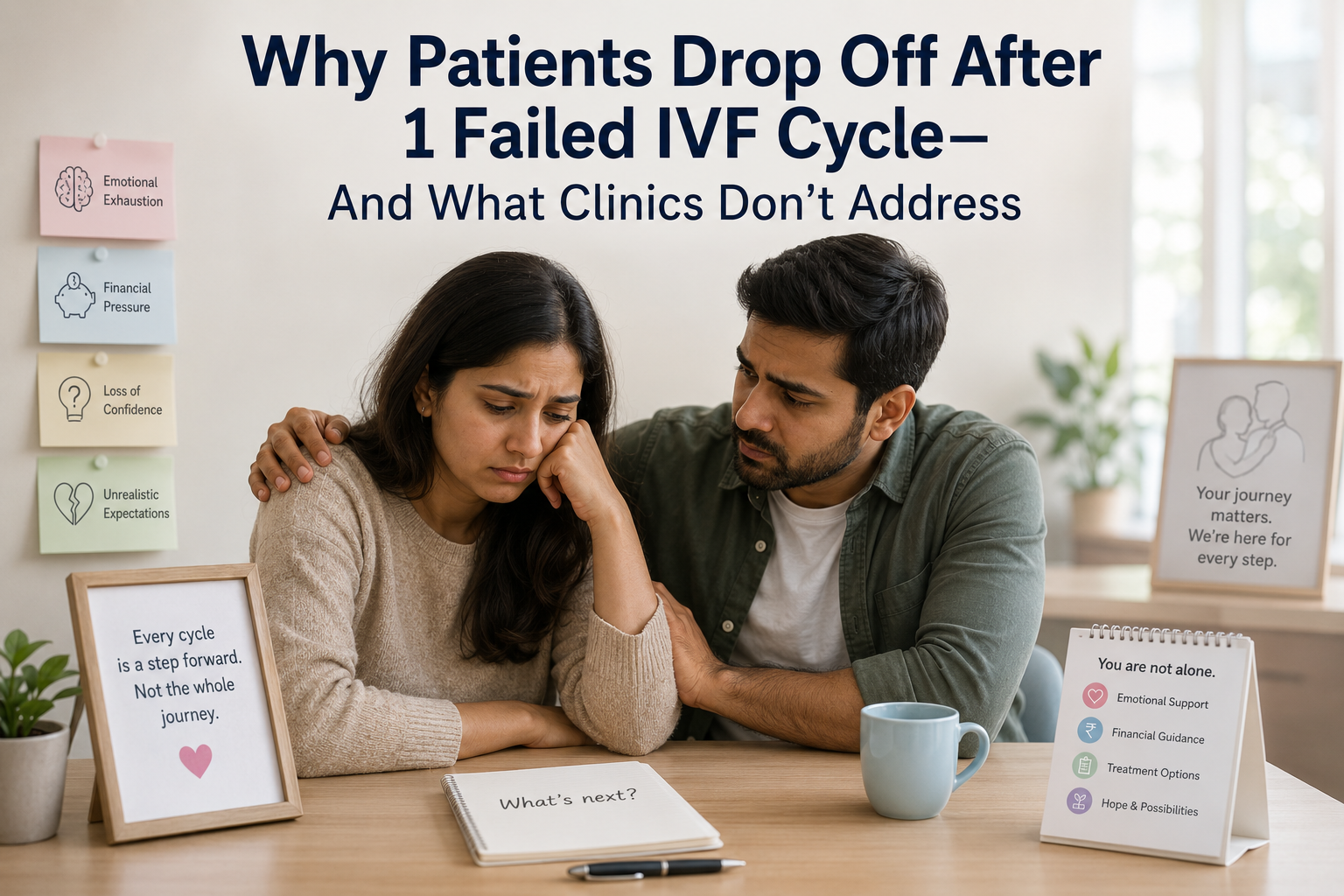
One of the most difficult moments in fertility treatment isn't starting IVF.
It's hearing that the first cycle didn't work.
For many patients, that result brings more than disappointment. It brings confusion, self-doubt, frustration, and a difficult question:
"Should we continue?"
While some patients move forward with another cycle, many do not.
In fact, a significant number of patients discontinue fertility treatment after their first unsuccessful IVF attempt.
Not necessarily because there are no options left.
But because the emotional, financial, and psychological burden becomes difficult to carry forward.
Most Patients Prepare for Treatment—Not Failure
Before starting IVF, patients often spend weeks or months preparing.
They learn about:
- Hormone injections
- Egg retrieval
- Embryo transfers
- Success rates
- Treatment timelines
What many patients are less prepared for is the possibility that the first cycle may not result in a pregnancy.
This is understandable.
When people begin IVF, they naturally focus on the outcome they hope to achieve.
But IVF is not a guaranteed treatment.
It is a process that works on probability rather than certainty.
And that distinction becomes very important when expectations meet reality.
Why Patients Stop After One Failed IVF Cycle
There is rarely a single reason.
More often, several factors come together.
1. They Expected IVF to Work the First Time
Many patients begin IVF believing that success is likely within the first cycle.
Part of this comes from success stories.
Part of it comes from the natural optimism that accompanies any major treatment decision.
When the cycle fails, the reaction is often:
"Something must have gone wrong."
In reality, unsuccessful first cycles are not uncommon.
A failed cycle does not automatically mean the treatment plan was incorrect or that future attempts are unlikely to succeed.
But when expectations are built around a quick outcome, disappointment can feel much greater.
2. The Emotional Exhaustion Is Harder Than Expected
IVF is often described as physically demanding.
Less attention is given to the emotional side of the process.
Patients spend weeks moving between hope and uncertainty.
Appointments, medications, procedures, waiting periods, and test results create an emotional cycle that can be difficult to sustain.
When treatment doesn't work, many patients feel emotionally depleted.
For some, the idea of immediately starting another cycle feels overwhelming.
3. Financial Fatigue Becomes a Major Barrier
A failed IVF cycle is not only emotionally challenging.
It can also create significant financial pressure.
Many patients budget for treatment assuming success within one or two attempts.
When additional cycles become necessary, the financial reality changes.
Costs may include:
- Repeat treatment cycles
- Medications
- Embryo freezing and storage
- Travel and accommodation
- Time away from work
For some patients, the question is no longer whether they want to continue.
It is whether they can.
4. Trust Begins to Erode
After an unsuccessful cycle, patients often start asking difficult questions.
- Was the diagnosis accurate?
- Was the treatment plan right?
- Should I get a second opinion?
- Should I change clinics?
These questions are normal.
However, when patients do not fully understand why a cycle was unsuccessful, uncertainty can gradually turn into loss of confidence.
Sometimes patients stop treatment not because they have lost hope in IVF, but because they have lost trust in the process.
A Simple Way to Think About It
Consider two patients beginning IVF.
Patient A starts treatment believing that one cycle should be enough.
Patient B starts treatment understanding that IVF may require multiple attempts.
If both experience a failed first cycle, their reactions are likely to be very different.
Patient A may see the outcome as a major setback.
Patient B may see it as disappointing, but still part of the expected journey.
The treatment outcome is the same.
The expectation entering treatment is not.
What Clinics Often Don't Address
Most fertility clinics spend a great deal of time explaining how IVF works.
Patients learn about medications, procedures, laboratory processes, and success rates.
What is discussed less often is how patients should navigate disappointment if treatment doesn't succeed immediately.
This is not necessarily a failure of care.
It is often a gap in expectation-setting.
Patients may benefit from understanding from the beginning that:
- IVF success is rarely guaranteed
- Multiple cycles are common
- Treatment plans may evolve over time
- Each cycle provides new information
- A failed cycle does not always indicate future failure
These conversations can make difficult outcomes easier to process when they occur.
Common Mistakes Patients Make After a Failed IVF Cycle
In the days and weeks following an unsuccessful cycle, emotions often drive decision-making.
Some common reactions include:
Assuming IVF Doesn't Work for Them
One failed cycle does not determine future outcomes.
Many successful pregnancies occur after treatment adjustments or subsequent attempts.
Switching Clinics Immediately
Seeking a second opinion can be valuable.
However, changing clinics without understanding what happened during the first cycle may not always provide better answers.
Looking for a Single Cause
Patients often want one clear explanation.
In reality, fertility treatment outcomes are influenced by multiple biological factors, many of which cannot be fully controlled.
Stopping Without a Follow-Up Discussion
One of the most important appointments after a failed cycle is the review consultation.
Understanding what happened and what can be changed may help patients make more informed decisions about next steps.
What Should Patients Do After a Failed IVF Cycle?
Rather than asking:
"Why did IVF fail?"
A more useful question is:
"What did we learn from this cycle?"
Patients may benefit from discussing:
- Whether the treatment plan should change
- Embryo development and quality
- Egg and sperm factors
- Uterine considerations
- Additional investigations if required
- Realistic expectations for future cycles
The goal is not simply to repeat treatment.
It is to make better-informed decisions moving forward.
The Right Question Isn't "Should I Quit?"
After a failed cycle, many patients focus on a single decision:
"Should we continue?"
A more productive question may be:
"Do we have a clear plan for what comes next?"
The answer often provides more clarity than the result of the cycle itself.
Conclusion
A failed IVF cycle is disappointing.
There is no way around that reality.
But it is not always a verdict on the future.
For many patients, it is simply one step in a longer treatment journey.
The challenge is not only deciding whether to continue.
It is continuing with realistic expectations, good support, and a clear understanding of the road ahead.
Sometimes the most important part of fertility treatment is not what happens during the cycle.
It is what happens after it.
Frequently Asked Questions
Is it normal for IVF to fail the first time?
Yes. A failed first IVF cycle is relatively common and does not necessarily predict future treatment outcomes.
Why do many patients stop IVF after one failed cycle?
Patients may discontinue treatment due to emotional exhaustion, financial pressure, unrealistic expectations, or loss of confidence in the process.
Should I switch clinics after a failed IVF cycle?
Not necessarily. It is often helpful to first review the cycle in detail and understand what was learned before deciding whether a second opinion is needed.
Can IVF work after a failed first attempt?
Yes. Many patients achieve successful pregnancies in subsequent cycles, particularly when treatment plans are refined based on previous outcomes.
What should I ask my doctor after a failed IVF cycle?
Patients should discuss embryo development, treatment response, potential changes to the treatment plan, additional investigations, and realistic next steps.
How long should I wait before trying another IVF cycle?
The appropriate timing varies depending on medical factors, emotional readiness, and the recommendations of the treating fertility specialist.