What Low-Cost IVF Ads Don't Tell You About the Final Bill

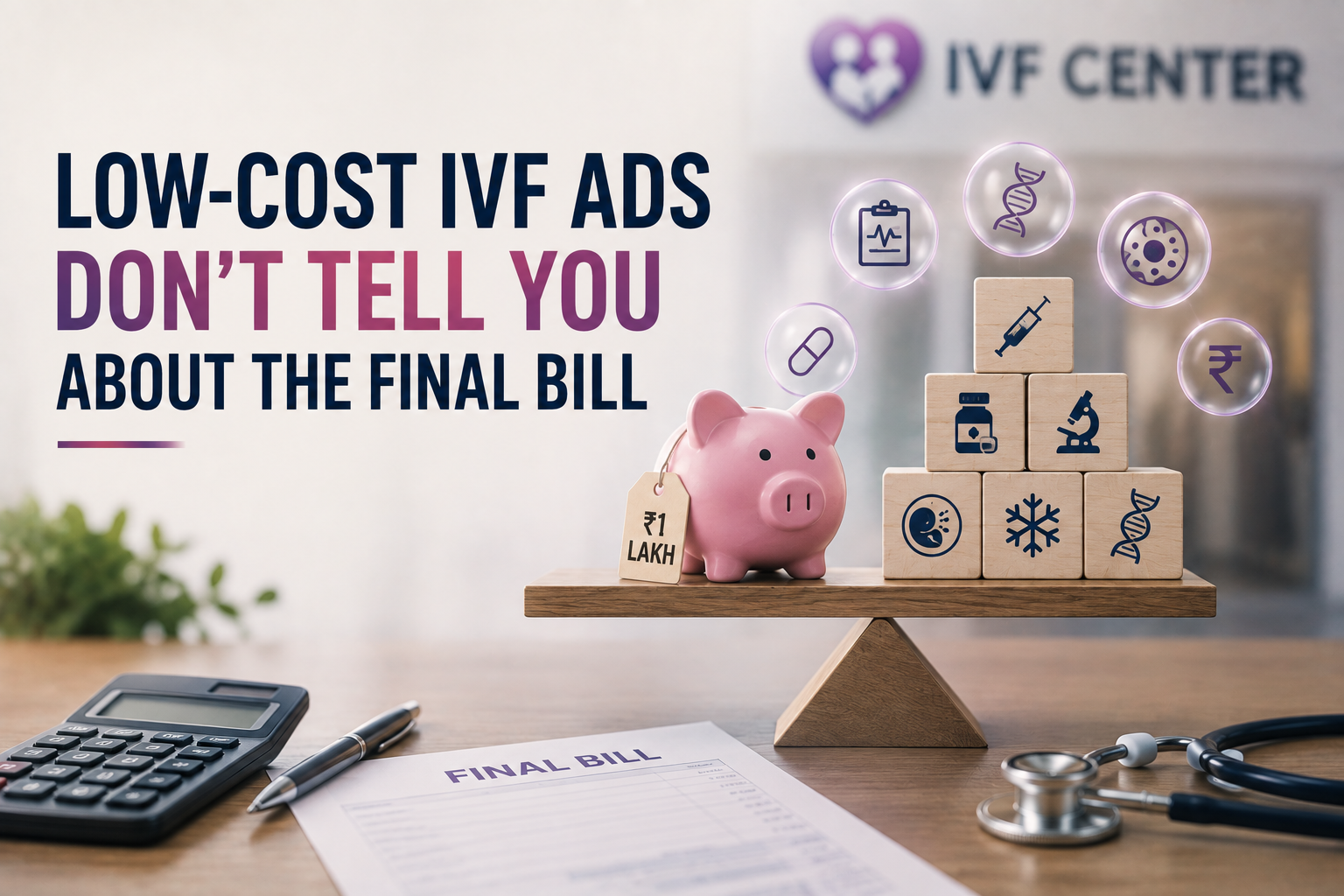
A "low-cost IVF" ad in India usually isn't lying — it's just not showing you the whole bill. The advertised figure, often pitched starting around ₹1 lakh, is typically the base cycle fee: stimulation, egg retrieval, and a standard transfer. Medications, monitoring, embryology charges, and anything beyond the standard protocol are frequently priced separately. By the time a cycle is actually complete, many patients find their real spend has landed closer to ₹2.5 lakh to ₹ 3 lakh — sometimes more, once add-ons enter the picture.
None of this means low-cost clinics are dishonest by default. It means the advertised number and the final invoice are often answering two different questions, and it's worth knowing the difference before you sign up.
Where the Real Cost Often Comes From: Add-Ons
Add-ons are optional extras offered alongside standard IVF — things like embryo glue, time-lapse imaging, endometrial scratching, PGT-A (genetic testing of embryos), or immune-related infusions, each marketed as something that might improve your odds. They're usually introduced after your first consultation, once you're already emotionally and financially invested in the process — which is exactly when they're hardest to evaluate objectively.
Here's what's worth knowing before you agree to any of them: as of now, not a single widely-offered IVF add-on carries a "proven to help" rating from the independent bodies that review this evidence internationally. Several are rated as having limited or mixed evidence; some show no good evidence of benefit at all outside of research settings. A review published this year assessed ten of the most commonly marketed add-ons and found seven showed no measurable improvement in outcomes, or had evidence too weak to support the claims made for them. This isn't India-specific science — it's the same embryology and reproductive medicine evidence base clinics everywhere draw from. What differs by country is how visible that evidence is to patients.
The Regulatory Gap Specific to India
India's Assisted Reproductive Technology (Regulation) Act, 2021 was a meaningful step forward — it requires clinics and ART banks to register, screen donors, follow consent protocols, and meet baseline standards of practice. What it doesn't yet include is an independent system that rates the evidence behind specific add-ons the way some other countries' fertility regulators do. In markets with that kind of rating system, patients can look up whether a specific add-on has been shown to work before agreeing to pay for it. In India, that verification largely doesn't exist in a standardized, publicly accessible form — which means the burden of asking the right questions falls almost entirely on the patient, in the middle of an already stressful decision.
What These Extras Actually Cost in India
Real numbers help make this concrete. PGT-A, genetic testing of embryos before transfer, commonly runs ₹25000 to ₹100000 depending on the clinic and the number of embryos tested. Embryo glue, a comparatively small add-on, is usually around ₹5000. Immune-related treatment such as IVIG infusions and LIT can run ₹35,000 to ₹40,000 per session — and some protocols call for more than one session, which multiplies quickly. Time-lapse imaging and other monitoring add-ons vary widely by clinic and aren't always quoted upfront, which is itself worth flagging as a transparency gap.
Stack two or three of these onto a base cycle advertised at ₹1 lakh, and the "low-cost" framing starts to look very different from the number you actually pay.
Why This Hits Differently in India's Out-of-Pocket Market
Most Indian health insurers offer little to no coverage for IVF. A small number now offer limited, maternity-linked riders, but for the overwhelming majority of patients, the entire cost — base cycle, medications, and any add-ons — comes directly out of pocket. That changes the stakes considerably compared to markets where insurance absorbs part of the cost. Every add-on you agree to isn't a marginal decision; it's money that isn't going toward medications for this cycle, or toward a second full attempt if this one doesn't succeed. And because IVF frequently takes more than one cycle to succeed, patients who overspend on unproven extras in cycle one sometimes have less financial room for cycle two — which, statistically, may have mattered more.
Red Flags Worth Noticing in Low-Cost Advertising
A few patterns are worth paying attention to when comparing clinics on price: vague claims like "high success guaranteed" without any age- or diagnosis-specific context; "unlimited cycle" packages that don't clearly define what's included in each attempt; reluctance to provide a fully itemized quote in writing before you commit; and add-ons introduced verbally during a consultation rather than listed transparently on a written price sheet from the start. None of these automatically mean a clinic is acting in bad faith, but each is a reasonable prompt to ask more questions before paying anything.
How to Get the Real Number Before You Commit
- Ask for a complete itemized quote in writing, covering medications, monitoring, embryology charges, and any add-ons the clinic typically recommends
- For any add-on suggested to you, ask directly what evidence supports it, what it costs specifically, and whether it's relevant to your individual diagnosis or offered to most patients by default
- Confirm the clinic's registration status under the ART (Regulation) Act, 2021, which is a baseline indicator of compliance, though not a guarantee of value for money
- Consider whether the money is better spent on a second full cycle later, rather than stacking several unproven extras onto a single one
Questions Worth Asking a Clinic Directly
- What is included in your advertised base price, and what typically gets added on top of it?
- Of the add-ons you're recommending for my case, which ones have strong evidence, and which are more precautionary?
- Can I get a full written cost breakdown before I begin the cycle, not after?
Frequently Asked Questions
Are all IVF add-ons a waste of money? Not necessarily — some may be appropriate for specific medical situations. The issue is when they're marketed broadly to all patients regardless of evidence or individual need.
How do I know if an add-on is evidence-based? Ask your clinic directly what evidence supports it, and don't be discouraged from asking for the underlying research, not just a summary.
Why would a clinic offer something with weak evidence? Sometimes it reflects genuine belief the treatment may help in specific cases; sometimes it reflects patient demand or competitive pressure. Either way, it's reasonable to ask which applies to your recommendation.
Is a cheaper clinic automatically a worse choice? Not at all — price alone doesn't indicate quality. What matters more is transparency about what's included and what evidence supports anything added on top.
Talk to a Fertility Specialist
Before agreeing to any add-on, ask what it costs, what evidence supports it, and whether it's specifically relevant to your case rather than a standard upsell. A transparent answer to that question tells you a lot about the clinic.
This article is for general informational purposes and isn't a substitute for personalized medical advice. Talk to your fertility specialist about your specific situation before making treatment decisions.