Time-Lapse Embryo Imaging: Does It Really Improve IVF Outcomes in Indian Clinics?

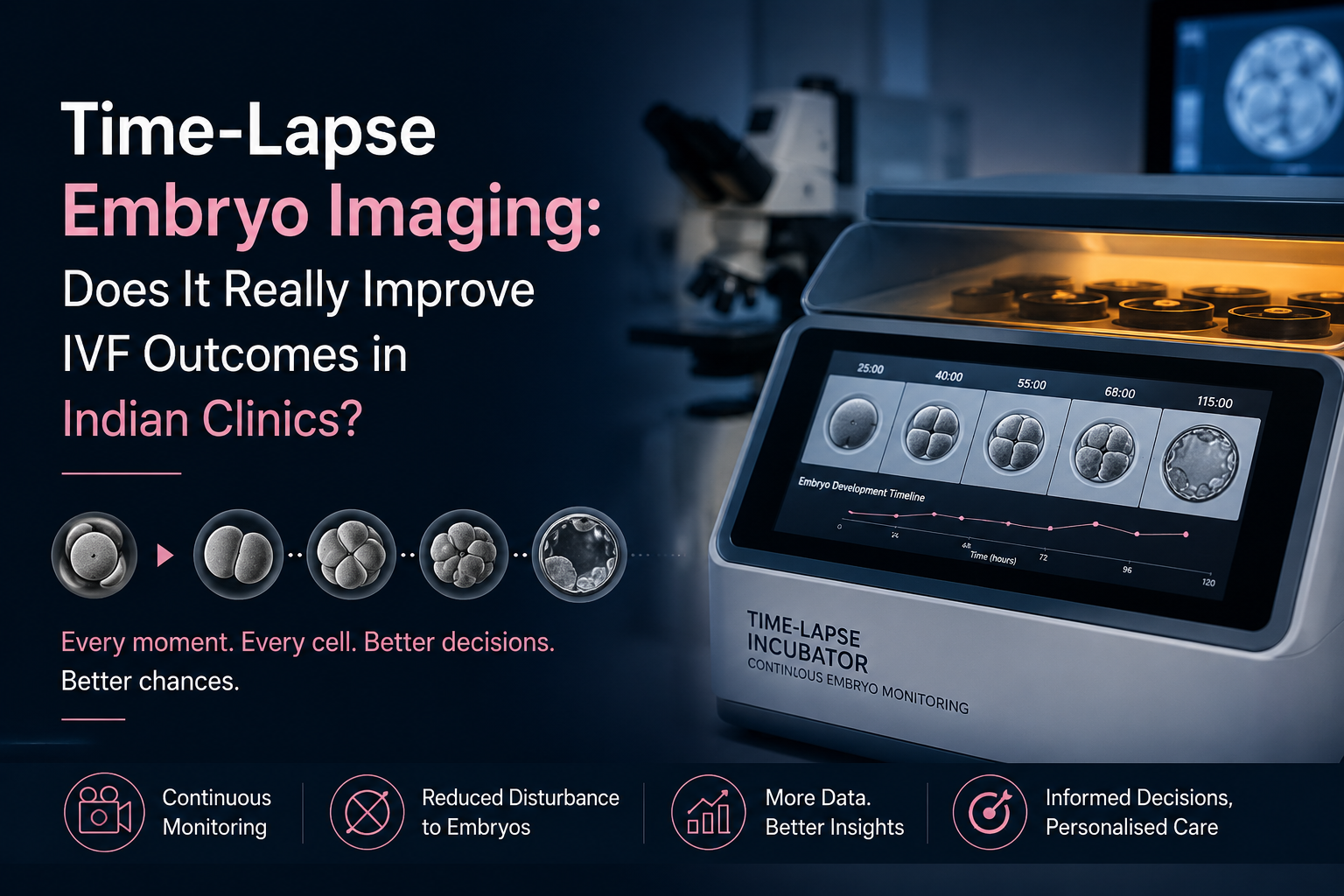
In many IVF clinics today, patients are introduced to a newer technology called time-lapse embryo imaging.
It is often presented as an advanced method for continuously monitoring embryos and identifying the one most likely to result in a successful pregnancy.
The idea is appealing. If doctors can observe embryo development more closely and in real time, shouldn’t that improve success rates?
But a more important question remains: Does time-lapse imaging actually improve IVF outcomes — or does it mainly change how embryos are observed rather than how pregnancies occur?
What Time-Lapse Embryo Imaging Actually Means
In traditional IVF labs, embryologists assess embryos at specific time points. This involves briefly removing embryos from the incubator to examine their development under a microscope.
Time-lapse imaging changes this process.
Special incubators with built-in cameras capture continuous images of embryos as they develop. These images are compiled into a video, allowing embryologists to observe developmental patterns without disturbing the embryo’s environment.
This offers two main advantages:
- Continuous monitoring of embryo development
- Reduced the need to remove embryos from stable incubation conditions
In theory, this provides more detailed information and a more stable environment for embryo growth.
What the Technology Promises
Time-lapse systems are often positioned as a way to:
- Identify embryos with the highest implantation potential
- Improve embryo selection accuracy
- Increase IVF success rates
- Reduce subjectivity in embryo grading
For patients already navigating a complex and emotionally demanding process, this can sound like a meaningful upgrade.
What the Evidence Actually Shows
Time-lapse imaging does provide more detailed information about embryo development. It allows embryologists to observe subtle timing patterns that may not be visible during routine checks.
However, the key question is not whether more data is available —It is whether this data consistently improves outcomes.
So far, research has shown mixed results.
Some studies suggest improved embryo selection in certain settings. But strong and consistent evidence showing higher live birth rates across all patient groups remains limited.
In many cases, time-lapse imaging improves how embryos are observed, but not necessarily how often pregnancies occur.
A Simple Way to Think About It
For example:
A 30-year-old patient with good-quality embryos may not see a significant improvement in outcomes simply by using time-lapse imaging. Standard embryo assessment may already be sufficient in such cases.
In contrast, when embryo development patterns are unclear or previous IVF cycles have failed, time-lapse imaging may provide additional insights to help embryologists make more informed decisions.
The value of this technology often depends on the specific clinical context — not every patient benefits in the same way.
Why Time-Lapse Technology Is Widely Adopted
Despite evolving evidence, time-lapse imaging has been adopted by many IVF clinics.
There are several reasons for this:
1. Perception of Advanced Technology
Patients often associate newer technology with better outcomes. Clinics offering time-lapse systems may be seen as more advanced, even if outcome differences are not always significant.
2. Improved Laboratory Workflow
Continuous monitoring reduces the need to handle embryos frequently, which can help standardise lab processes and reduce variability.
3. Competitive Differentiation
In a competitive IVF market, offering advanced lab technology can influence patient choice, especially when comparing clinics.
4. Potential (but Not Guaranteed) Benefits
Time-lapse imaging may be useful in specific situations, but it is not a universal solution for improving success rates.
What Patients Should Realistically Expect
Time-lapse imaging can improve how embryologists observe and document embryo development. It may also help maintain a more stable environment by reducing disturbance.
However, IVF success depends on multiple biological factors that this technology cannot fully control, including:
- Egg quality and maternal age
- Sperm health
- Embryo genetics
- Uterine receptivity
- Overall reproductive health
Even with continuous monitoring, selecting an embryo remains a complex biological decision.
For many patients, time-lapse imaging may offer incremental benefits — but it does not guarantee higher chances of pregnancy.
What to Ask Your IVF Clinic About Time-Lapse Imaging
If a clinic recommends time-lapse embryo imaging, consider asking:
- Does this technology improve success rates in my specific case? The answer may vary depending on age, medical history, and embryo quality.
- Is time-lapse imaging used for all patients or selectively? Understanding whether it is routine or case-specific can provide clarity.
- Does it change how embryos are selected? Ask whether it adds meaningful insight beyond standard embryo grading.
- Does it increase the cost of treatment? Time-lapse systems may be offered as an add-on, so it is important to understand the financial implications.
Clear answers can help you decide whether the technology is necessary in your situation.
Conclusion
Time-lapse embryo imaging is a valuable advancement in IVF laboratories. It allows for continuous monitoring and may improve consistency in how embryos are assessed.
At the same time, current evidence does not consistently show that it significantly increases live birth rates for all patients.
For patients, the key is to understand that more detailed observation does not always translate into better outcomes.
Technology can support decision-making — but IVF success still depends largely on biological factors and overall clinical care.
Frequently Asked Questions
What is time-lapse embryo imaging in IVF? Time-lapse embryo imaging is a technology that uses special incubators with built-in cameras to continuously monitor embryo development without removing them from the incubator.
Does time-lapse imaging improve IVF success rates? It may help embryologists observe embryos more closely, but strong evidence showing consistently higher live birth rates is still limited.
Is time-lapse imaging better than traditional embryo monitoring? It provides more detailed information and reduces disturbance to embryos, but this does not always translate into significantly better outcomes.
Should all IVF patients choose time-lapse imaging? Not necessarily. The benefit may vary depending on individual factors, and it is not required for all IVF cycles.
Does time-lapse imaging increase IVF costs? Yes, in some clinics it is offered as an additional service, which may increase the overall cost of treatment.
Can time-lapse imaging guarantee better embryo selection? No. While it provides more data, embryo selection still depends on multiple biological factors and clinical judgment.