Freeze-All IVF: When It Helps, and When It Might Not

Fertility medicine has changed considerably over the past decade, and one of the more consequential shifts has been the growing use of freeze-all IVF cycles. Where clinics once routinely transferred embryos within days of fertilisation, many now freeze everything and schedule the transfer for a later date. The technology that made this possible — vitrification, a rapid-freezing technique that dramatically improved embryo survival rates after thawing — genuinely transformed what was feasible. But technology enabling something and that something being right for every patient are two different questions.
What a freeze-all cycle actually involves
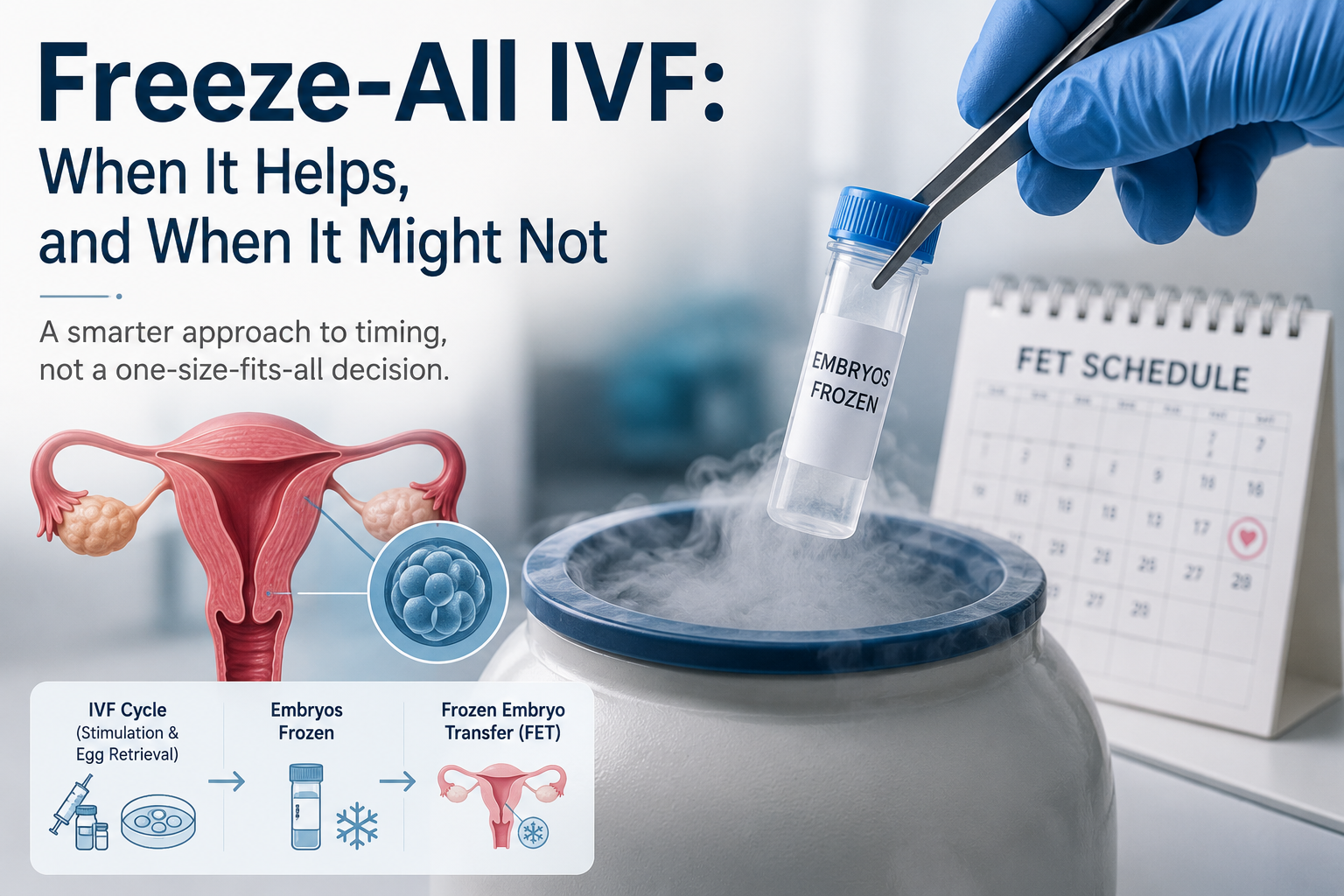
In a standard IVF cycle, eggs are retrieved, fertilised, and one or more of the resulting embryos is transferred back to the uterus within the same treatment cycle — typically three to five days after fertilisation. A freeze-all cycle breaks that sequence. The embryos are created, frozen, and then transferred weeks or months later in a separate procedure called a frozen embryo transfer (FET). The physical process of stimulation and retrieval is the same; what changes is the timing of everything that follows.
The clinical rationale — and where it's solid
There are patients for whom delaying transfer makes clear medical sense, and it's worth being specific about who they are.
The strongest case involves ovarian hyperstimulation syndrome (OHSS), a potentially serious response to fertility medications in which the ovaries over-respond to stimulation. In patients showing signs of an exaggerated response — elevated estradiol levels, a large number of developing follicles, abdominal discomfort — proceeding to an immediate embryo transfer adds risk without obvious benefit. Allowing the body to recover before transfer is the conservative and generally well-supported choice.
Related to this is the question of the uterine environment during stimulation. Some research suggests that the hormonal conditions present during an IVF stimulation cycle may not be optimal for implantation in certain patients. Separating the transfer from the stimulation phase allows the uterus to be prepared under more controlled conditions, which may matter for some women more than others.
There are also situations where transfer simply has to wait — a patient beginning cancer treatment who needs embryos frozen before chemotherapy starts, or someone who requires additional testing before a transfer decision can be made. In these cases, freezing isn't a protocol choice; it's the only sensible path.
Where the evidence gets more complicated
Outside these specific scenarios, the picture is less clear. Several large randomised trials have compared outcomes from fresh and frozen transfers in patients who don't have a particular medical reason to delay, and the results have been genuinely mixed. Some studies found modest improvements in live birth rates with frozen transfer in certain subgroups. Others found no meaningful difference. A few large trials in normal responders actually found fresh transfer outcomes to be comparable or, in some analyses, marginally better.
This doesn't mean frozen transfer is worse. It means the relationship between freezing strategy and outcome is more dependent on patient characteristics than on the approach itself. Age, ovarian reserve, embryo quality, the protocol used to prepare the uterus for FET — all of these interact in ways that aggregate statistics tend to smooth over.
The wider adoption question
The broader adoption of freeze-all strategies across clinics is partly a function of genuine clinical benefit, and partly a function of how medicine tends to absorb new capabilities. Vitrification worked well. Frozen transfer outcomes improved. Clinics became more comfortable with the approach, scheduling became more manageable, and freeze-all began appearing in protocols for patients who might previously have had a fresh transfer without any loss of success.
None of that is necessarily wrong. But it does mean that "we freeze all embryos now" can sometimes be a policy answer to a clinical question. The relevant question for any individual patient isn't what a clinic's default protocol is — it's whether that protocol is the right one given their specific response to stimulation, their hormone levels at the time of retrieval, and their overall reproductive picture.
What patients should be asking
The most useful thing a patient can do when freeze-all is recommended is ask for the reasoning specific to their situation. A clear answer — elevated progesterone levels, risk of OHSS, a finding that warrants further investigation before transfer — is reassuring. A vague answer along the lines of "we've found better outcomes this way" is worth pressing on. Better outcomes in which patients? Under what conditions?
It's also worth asking about the added timeline. FET cycles aren't complicated, but they do add weeks to the process, and for patients who are already navigating time pressure — whether due to age, financial constraints, or simply the emotional weight of treatment — that's not a trivial consideration.
The point isn't to be skeptical of freezing
Frozen embryo transfer has made IVF more flexible, safer in high-risk patients, and in some cases more effective. That's a genuine clinical advance. The point isn't to treat freeze-all as inherently suspect, but to treat it as a tool with a defined set of indications rather than a universal upgrade. The same logic applies to every intervention in medicine: the question isn't whether it works, but whether it's the right choice for this patient, at this time, given these circumstances.
For patients where the evidence is clear — significant OHSS risk, hormone levels that suggest a suboptimal uterine environment, a medical reason to delay — freeze-all is the right call. For patients where none of those factors are present, a fresh transfer remains a legitimate option, and the decision deserves a conversation rather than a default.