AI in IVF Labs: Decision Support or Decision Replacement?

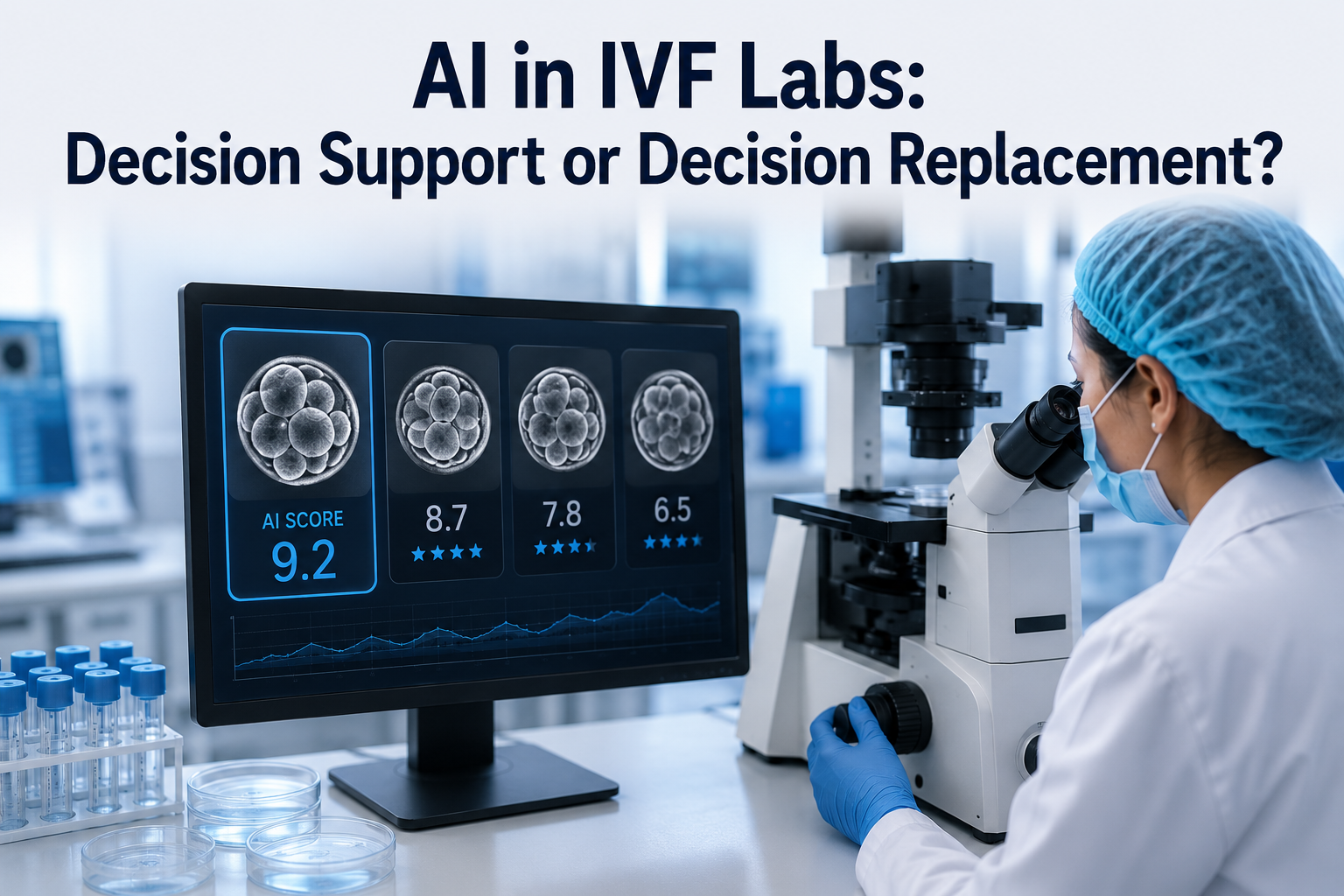
If an AI system and an experienced embryologist recommend different embryos for transfer, who should make the final decision?
A decade ago, that question would have sounded hypothetical.
Today, it is becoming increasingly relevant.
Artificial intelligence is gradually finding its way into IVF laboratories, promising faster analysis, greater consistency, and better decision-making.
Some clinics market AI as the future of fertility treatment.
Others remain cautious.
As the technology becomes more common, an important question is emerging:
Should AI help embryologists make decisions—or eventually replace them?
The short answer is simple:
Not anytime soon.
What Does AI Actually Do in an IVF Lab?
One reason AI generates so much discussion is that many patients are unclear about what it actually does.
AI is not creating embryos.
AI is not performing IVF procedures.
AI is not making treatment plans independently.
Instead, AI systems are typically used to analyse large amounts of laboratory data and assist embryologists in evaluating embryos.
Depending on the technology being used, AI may help:
- Analyse embryo images
- Perform AI embryo grading
- Monitor embryo development patterns
- Identify subtle changes during growth
- Assess embryo quality
- Support embryo selection decisions
In simple terms, AI helps process information.
The final clinical decisions still involve human expertise.
Why Is AI Attracting So Much Attention in Fertility Care?
The appeal is easy to understand.
Human judgment can vary.
Two experienced embryologists reviewing the same embryo may not always arrive at identical conclusions.
AI offers the possibility of:
- Greater consistency
- Faster analysis
- Pattern recognition at scale
- Reduced subjectivity
Some systems can review thousands of embryo images and identify developmental patterns that may be difficult for the human eye to detect.
This has led to growing interest in whether AI can improve embryo selection and ultimately improve IVF outcomes.
The Promise of AI in Embryo Selection
One of the most common applications of AI in IVF is embryo assessment.
Traditionally, embryologists evaluate embryos based on appearance and developmental milestones.
AI systems attempt to add another layer of analysis.
By reviewing large datasets, algorithms can identify patterns associated with embryo development and provide scores or rankings that may assist decision-making.
Many modern platforms use AI embryo grading systems to help embryologists assess developmental patterns more consistently.
The goal is not necessarily to replace existing assessment methods.
It is to provide additional information that may help embryologists make more informed choices.
This is why many experts view AI as a support tool rather than a standalone solution.
AI vs Human Embryologists: Who Makes Better Decisions?
Patients sometimes assume AI and human expertise compete against each other.
In reality, they serve different roles.
AI can analyse large volumes of embryo images quickly and consistently. It can identify subtle patterns that may not always be obvious during manual review.
Human embryologists bring clinical experience, judgment, and context that algorithms cannot fully replicate.
An AI system may identify which embryo appears strongest based on available data.
An embryologist can evaluate that information alongside laboratory observations, patient history, and other clinical factors.
The most effective IVF laboratories do not rely exclusively on either one.
Instead, they combine AI-driven analysis with human expertise to support better decision-making.
Can AI Improve IVF Success Rates?
This is one of the most common questions patients ask.
The answer is more complicated than many headlines suggest.
AI may help improve consistency in embryo evaluation.
It may also help laboratories process information more efficiently.
However, fertility treatment involves far more than embryo images.
Success depends on factors such as:
- Egg quality
- Sperm quality
- Embryo genetics
- Uterine health
- Maternal age
- Overall reproductive health
Because IVF outcomes are influenced by so many variables, AI alone cannot guarantee higher pregnancy rates or live birth rates.
Current evidence remains promising, but it does not support the idea that AI can eliminate uncertainty from fertility treatment.
Is AI Better Than Human Embryologists?
Not necessarily.
The value of AI lies in supporting human decision-making rather than replacing it.
AI excels at analysing large datasets, recognising patterns, and improving consistency.
Human embryologists contribute experience, clinical judgment, and the ability to interpret findings within a broader medical context.
The strongest IVF outcomes are likely to come from combining both.
Rather than asking whether AI is better than embryologists, a more useful question is whether AI is being used effectively alongside experienced professionals.
The Problem With Treating AI as an Oracle
Technology often creates an illusion of certainty.
When an algorithm produces a score, it can feel objective and definitive.
But biology rarely works that way.
A highly ranked embryo may not implant.
A lower-ranked embryo may result in a healthy pregnancy.
This is because fertility treatment involves biological complexity that no algorithm can fully capture.
AI can analyse patterns.
It cannot predict the future with certainty.
And it cannot account for every variable that influences reproductive outcomes.
A Simple Way to Think About It
Most people use GPS when driving.
The technology is helpful.
It can identify routes, estimate travel times, and suggest alternatives.
Yet most drivers still pay attention to the road.
If the GPS recommends a route that is clearly blocked, the driver does not blindly follow it.
AI in IVF works in a similar way.
It can provide guidance.
But expertise, judgment, and context still matter.
What AI Cannot Replace
Despite rapid advances, AI has important limitations.
It cannot fully replace:
Clinical Judgment
Treatment decisions often require interpretation rather than calculation.
Patient Context
Every fertility journey is unique.
Medical history, previous treatment outcomes, and individual circumstances all matter.
Treatment Planning
Successful fertility care requires personalised decision-making.
Communication and Counselling
Patients need explanations, reassurance, and support.
These remain fundamentally human responsibilities.
Experience
Embryologists and fertility specialists often recognise nuances that extend beyond what current algorithms can measure.
Decision Support or Decision Replacement?
This is where the discussion becomes clearer.
The most realistic role for AI today is not decision replacement.
It is decision support.
AI can help specialists process information more efficiently and identify patterns that might otherwise be overlooked.
But the final responsibility for treatment decisions still belongs to trained professionals.
The strongest outcomes are likely to come from a combination of:
- Technology
- Laboratory expertise
- Clinical judgment
- Patient-centred care
Rather than replacing embryologists, AI is more likely to become another tool within the IVF laboratory.
Common Misconceptions About AI in IVF
As AI becomes more visible in fertility care, misconceptions are becoming more common.
AI Guarantees Better IVF Success Rates
No.
AI may assist embryo assessment, but it cannot guarantee treatment outcomes.
AI Can Predict Pregnancy With Certainty
No.
Fertility treatment remains influenced by multiple biological variables.
AI Replaces Embryologists
No.
Embryologists continue to play a central role in laboratory decision-making.
Clinics Using AI Automatically Provide Better Treatment
Not necessarily.
Technology is only one component of quality care.
Laboratory standards, embryologist expertise, and clinical experience remain equally important.
Questions Patients Should Ask About AI in IVF
If a clinic uses AI-based tools, patients may consider asking:
How is AI used in your laboratory?
Understanding its role helps set realistic expectations.
Does AI influence embryo selection decisions?
Different clinics may use the technology in different ways.
Who makes the final decision?
AI may provide recommendations, but patients should understand where human oversight exists.
What evidence supports the technology being used?
Evidence-based adoption is more important than marketing claims.
The Bigger Question Patients Should Be Asking
When patients hear about AI in IVF, the natural question is:
"Does this technology improve my chances?"
A better question may be:
"How is this technology being used alongside human expertise?"
Because the future of fertility care is unlikely to be human versus machine.
It is more likely to be human expertise supported by better technology.
Conclusion
Artificial intelligence may become one of the most important tools in modern IVF laboratories.
Its ability to analyse large volumes of data and identify patterns makes it an exciting development in fertility care.
But tools and decision-makers are not the same thing.
Today, AI works best as a support system—not a replacement for experienced embryologists and fertility specialists.
The future of IVF will not be defined by algorithms alone.
It will be defined by how effectively technology and human expertise work together.
Frequently Asked Questions
What is AI used for in IVF labs?
AI is commonly used to analyse embryo images, perform AI embryo grading, assess developmental patterns, support embryo selection, and assist embryologists in processing laboratory data.
Can AI improve IVF success rates?
AI may improve consistency in embryo evaluation, but it cannot guarantee higher pregnancy rates or eliminate uncertainty from fertility treatment.
Is AI better than human embryologists?
Not necessarily. AI is designed to support human expertise, not replace it. The best outcomes are likely to come from combining AI analysis with experienced clinical judgment.
Does AI replace embryologists?
No. AI supports embryologists by providing additional information, but clinical decisions still require human expertise and oversight.
How does AI help with embryo selection?
AI systems analyse large datasets and embryo development patterns to identify characteristics that may be associated with embryo quality.
Should patients choose a clinic because it uses AI?
Not necessarily. AI is one factor among many. Laboratory quality, embryologist expertise, clinical experience, and patient care remain equally important.
What questions should I ask a clinic about AI?
Patients can ask how AI is used, whether it influences embryo selection, who makes final decisions, and what evidence supports the technology being used.